TO EDUCATE
◆
TO PROCLAIM
◆
TO TRANSFORM
JOIN US
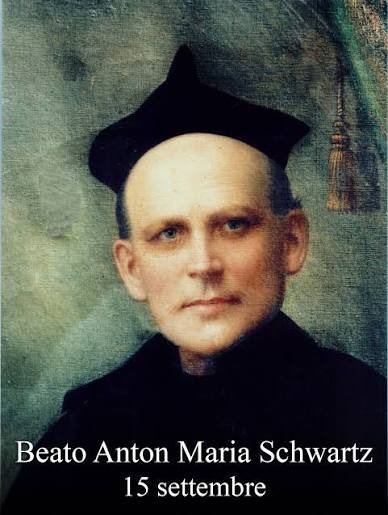
Austrian priest and social apostle who founded the Calasanzian Congregation for the Christian formation, vocational education, and pastoral care of workers, apprentices, and laborers.
Anton Schwartz was born on 28 February 1852 in Baden, Austria, the fourth of fourteen children. His childhood was marked by simplicity, strong Christian values, and a love for sacred music, serving as a choir boy in his parish.
After the death of his father when Anton was only fifteen, the family experienced severe financial hardship. These early struggles gave him a lifelong compassion for poor families, workers, and young apprentices.
Feeling called to religious life, Anton entered the Piarist novitiate at the age of seventeen and developed a deep devotion to St. Joseph Calasanz. However, fearing political suppression of religious institutes in the German Empire, his superiors advised him to leave the novitiate.
He continued his vocation as a seminarian for the Archdiocese of Vienna and was ordained a priest on 25 July 1875 by Cardinal Joseph Othmar Rauscher. During his formation he suffered a life-threatening lung illness but recovered remarkably, seeing his healing as God's providence for the mission that awaited him.
As a young priest, Blessed Antonio dedicated himself to serving workers, craftsmen, and apprentices during the rapid industrialization of Austria. He witnessed the poverty, exploitation, and difficult living conditions faced by laborers and believed that the Church had a responsibility to accompany them with both spiritual care and practical assistance.
In 1888, he founded a magazine for workers, encouraging Christian values, dignity in labor, and social responsibility.
On 24 November 1889, Blessed Antonio founded the Congregation of the Christian Workers of St. Joseph Calasanz (Calasanzian Congregation). Inspired by the educational vision of St. Joseph Calasanz, the congregation dedicated itself to:
His community followed the spiritual tradition of the Piarists while adapting its mission to the needs of working people.
Blessed Antonio spent the final decades of his life guiding his congregation and expanding its educational and social ministries throughout Austria.
He died peacefully on 15 September 1929 in Vienna. Despite heavy rain, thousands gathered for his funeral, a testament to the profound impact he had made on workers, families, and the Church.
The Church officially recognized the holiness of Blessed Antonio María Schwartz through the process of beatification:
His beatification followed the recognition of a miraculous healing attributed to his intercession.
Blessed Antonio María Schwartz remains an inspiring example of:
His work continues through the Congregation of the Christian Workers of St. Joseph Calasanz, serving workers and young people with the same spirit of faith, dignity, and education.
"The dignity of work is fulfilled when labor is united with faith, justice, and the love of Christ."
Click any image to view at high resolution